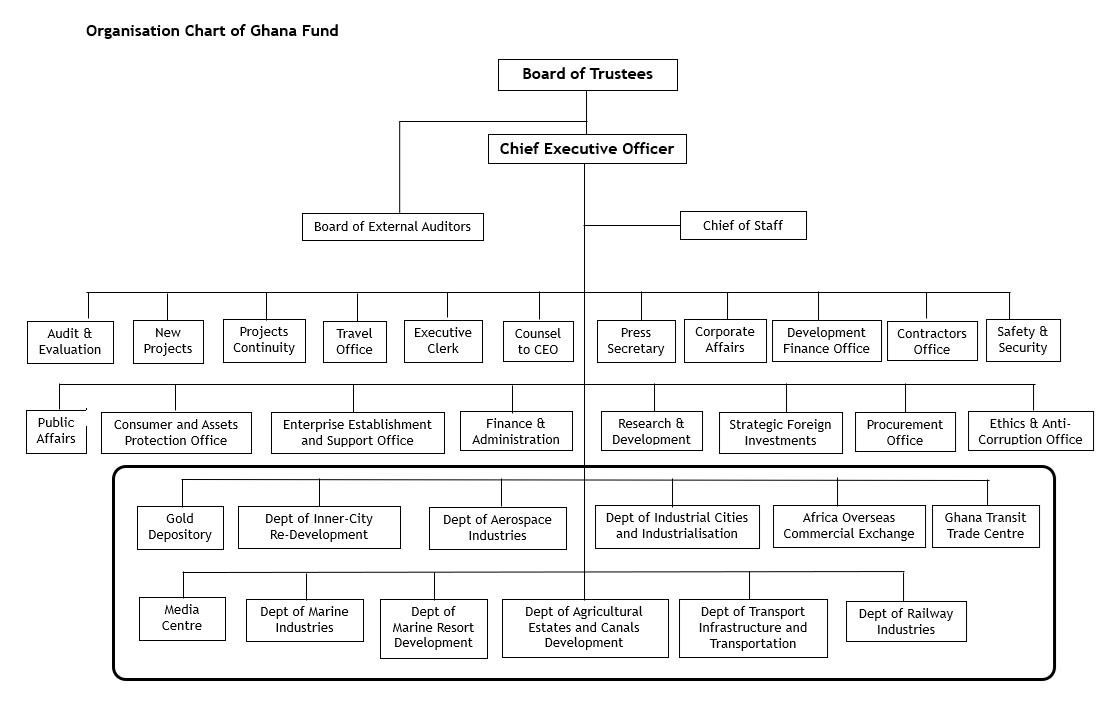
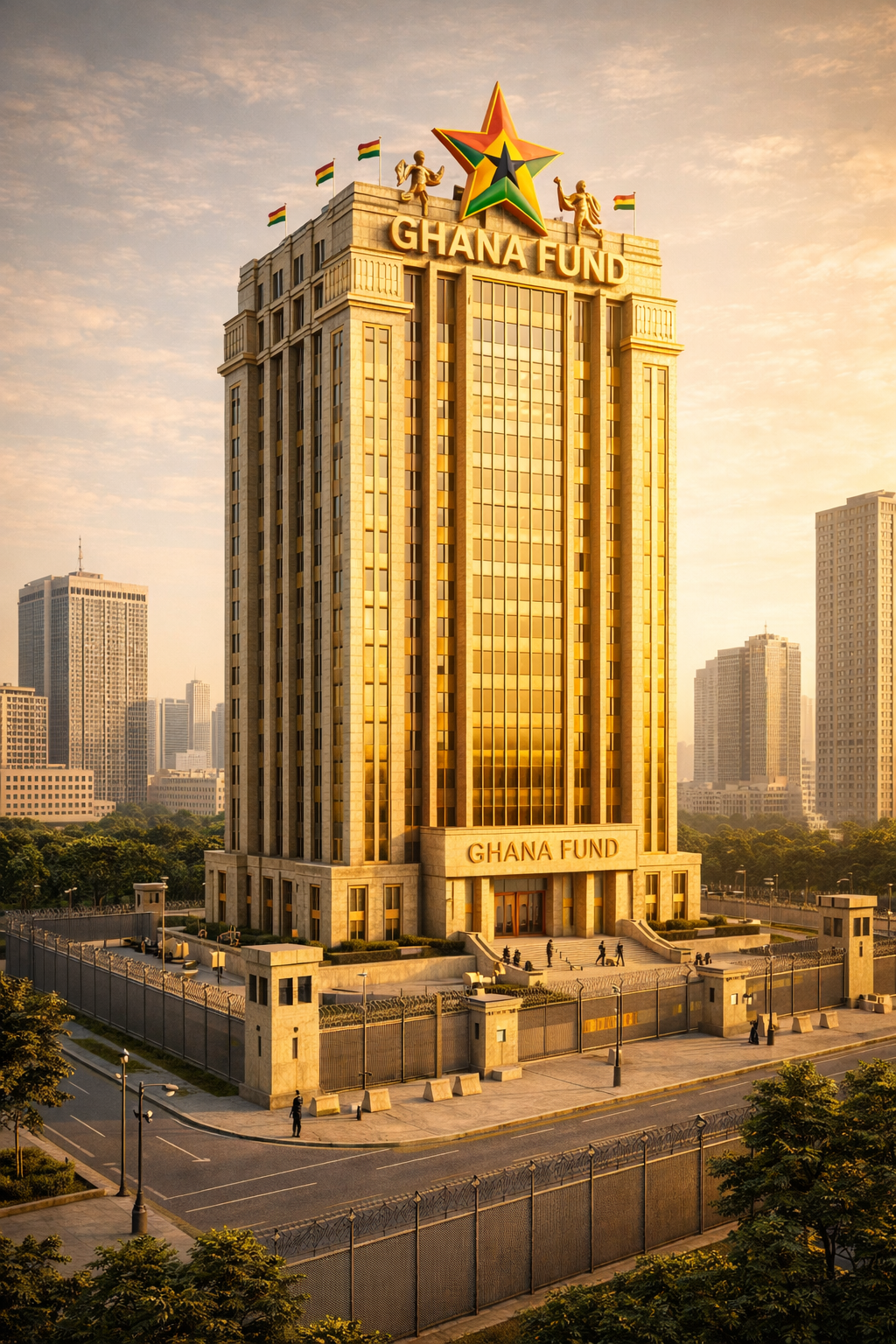
Structure of the Ghana Fund
Description of the Departments of the Ghana Fund
CHIEF OF STAFF
The Office of the Chief of Staff is responsible for directing, managing and overseeing all policy development, daily operations, and staff activities for the Chief Executive Officer. The office will coordinate and communicate with all departments and agencies of the Fund.
The Office is responsible for the planning, organisation, and implementation of the CEO's daily and long-range schedules. All requests for appointments, meetings, or time with the CEO must be directed through this office. In addition to scheduling the CEO's time, this office is responsible for the design and structure of activities at every location outside the Ghana Fund offices that the CEO and Trustees will visit.
The Office of the Chief of Staff is the primary coordinator of activities that seek to explain and promote the CEO's ideas on policies. Speech-writing and communications research operations.
Additionally, the Office is responsible for recruiting, screening, and recommending qualified staff and candidates for various positions and promotions.
AUDIT AND EVALUATION
The Office of Audit and Evaluation is responsible for providing professional and objective oversight functions designed to improve operational efficiency and effectiveness, to reinforce a culture of accountability and to strengthen the ethical climate of the Ghana Fund. It will assist the CEO in fulfilling the oversight responsibilities in respect of management, staff, and resources of the Ghana Fund by conducting investigations, internal audits, inspections, evaluations and other forms of assessment.
The Office will be planning, designing and developing the annual audit and evaluation programme, following an evidence-based and objective-centric approach, deliver and present high quality audit, evaluation, analysis and other assessment reports that clearly, fairly, and impartially communicate findings, risks, and recommended actions, with an analysis of root causes, patterns or trends as applicable, and contribute to innovation within the Ghana Fund through continuous professional development, participation in oversight professional practice groups, and horizon-scanning.
NEW PROJECTS
The Office of New Projects is responsible for new projects development from initiation to realisation, and making sure the work gets done efficiently and satisfactorily. Every project starts as an idea. It’s the responsibility of the New Projects Office to work with internal stakeholders and external beneficiaries to define that concept and create a process to bring it to fruition. This includes setting and managing beneficiary expectations, developing a detailed project plan, defining the scope of the project, understanding project risks and assigning team members to specific tasks. Keep beneficiaries up-to-date on the development process and ensure that beneficiaries are satisfied with the project delivery and performance.
PROJECTS CONTINUITY
All Ghana Fund projects are designed for long-term sustainability and efficiency, and the Projects Continuity Office is responsible for the supervision of project operators and actors to ensure that growth patterns and strategies are strictly followed, projects remain largely self-sustaining and efficient. The Office is also responsible for keeping the Ghanaian public updated on the progress and growth each project.
TRAVEL OFFICE
The Travel Office is responsible for handling all travels and hotel arrangements for all staff of the Ghana Fund. The staff of the department shall also be responsible for the management of travel and hotel arrangements including local transportation for visiting guests.
EXECUTIVE CLERK
The Executive Clerk's Office is responsible for the preparation and disposal of all official documents. It will communicate the CEO's policies to the Ghanaian public. The office will also keep the CEO informed as much as possible about the public's concerns and interests by analysing and responding to the CEO's mail, e-mail, and telephone calls received over the Public Comment Line. In addition, the department will perform individual case-work and assist persons seeking help from the Ghana Fund, oversee Volunteer Programmes, prepare messages and proclamations on behalf of the CEO, and acknowledge gifts given to the staff of Ghana Fund.
COUNSEL TO THE CEO
The Counsel advises the Chief Executive Officer on all legal issues concerning the Office of the Chief Executive Officer and the Ghana Fund. The Counsel's Office is responsible for advising on legal aspects of policy questions, legal issues arising in connection with the CEO’s decision to sign or reject instruments requiring his signature, questions on ethics, financial disclosures, conflict of interest during and post-employment, statutory requirements, and the separation official business from political activities. The Counsel's Office is also responsible for reviewing statements to be made by the CEO, and handle lawsuits brought against the CEO in his role as Trustee and Chief Executive Officer as well as lawsuits brought against the Ghana Fund.
PRESS SECRETARY
The Office of the Press Secretary has the primary responsibility of providing information to the press in accordance with the Ghana Fund press relations policies. It is the press contact and also responsible for the management of press meetings, preparing the CEO for press interviews, briefing staff and preparing staff for press meetings. The Office of the Press Secretary will coordinate the CEO’s weekly and monthly television address, video recordings, selected or approved social media feeds, and also provide the press with access to and information about various Ghana Fund events.
The Office of the Press Secretary will maintain a library of photographic and videographic materials and documentations. The office is responsible for editing and researching photo requests for the media, and individual photo opportunities.
CORPORATE AFFAIRS
The Corporate Affairs Department serves as the strategic communication, public relations, and stakeholder engagement engine of Ghana Fund. It safeguards the institution’s reputation, drives its brand visibility, manages government and public partnerships, and ensures clear, consistent communication across all national and international audiences while supporting the Fund’s mission of transforming Ghana’s development landscape.
DEVELOPMENT FINANCE OFFICE
The Development Finance Office is responsible for the following among other things: establish internal controls at the departmental level, maximize cash flow through effective internal procedures, timely billing, collection and depositing of revenue, maintain positive fund balances and cover deficits throughout the fiscal year, be aware of institutional policies concerning fund management, ensure compliance with fund purposes and/or restrictions, and ensure sufficient budget is available to support anticipated expenditures for the entire fiscal year.
CONTRACTORS OFFICE
The Contractors Office is responsible for negotiating, creating, and tracking contracts between Ghana Fund, businesses and their suppliers or vendors. The Office will work with the purchase of goods and services, review proposals, and select the best options. It will also be responsible for drafting initial contracts, reviewing client contracts for accuracy when they are returned, obtaining more information or signatures when required, and scanning and uploading contracts into our system.
SAFETY AND SECURITY
The Safety and Security Office has oversight responsibilities within all Ghana Fund premises and assets, and also ensure that safety and security measures at all project sites are in strict compliance with the policies of the Ghana Fund as well as any statutory requirements.
The Office will:
- plan and carry out security measures and measures to avert danger;
- assess potential dangers and take security measures;
- review and monitor adherence to relevant protective and security regulations, in particular those governing safety at work, fire prevention, environmental protection and data protection;
- test the proper functioning of safety and security installations and take measures in case of faults or short-comings;
- identify the way weapons work and their risk potential;
- able to react in an appropriate manner in the case of major emergencies;
- observe developments in the safety and security sector and assess the resulting impact on the Fund’s range of services;
- ensure projects beneficiary safety and security at all times through programmatic interventions; and
- investigate, clarify and document security-relevant facts and circumstances.
PUBLIC AFFAIRS
The Office of Public Affairs is responsible for ensuring that the CEO is aware of the concerns of any Ghanaian citizen. The office will liaise with the Office of the Chief of Staff and the Office of the CEO on matters of policy that of concern, and provide feed-back and public education with support from the Office of the Press Secretary.
It is also responsible for promoting the Fund’s priorities through outreach to concerned and public interest groups. This includes planning Ghana Fund briefings, meetings and large events with the CEO, Chief of Staff, and relevant Ghana Fund staff.
CONSUMER AND ASSETS PROTECTION OFFICE
The Ghana Fund Consumer and Assets Protection Office safeguards citizens and national assets by enforcing fair practices, monitoring project integrity, resolving consumer concerns, and ensuring all Ghana Fund initiatives deliver transparent, accountable, and secure value for the public.
ENTERPRISE ESTABLISHMENT AND SUPPORT OFFICE
The Enterprise Establishment and Support Office drives Ghana Fund’s mission by rapidly creating, scaling, and supporting high-impact enterprises across key sectors, ensuring each venture becomes a sustainable engine of national wealth and development.
MEDIA CENTRE
Ghana Fund’s Media Centre drives all communications, producing high-impact content, managing press relations, shaping public narrative, and ensuring consistent brand visibility. It serves as the institution’s storytelling engine—delivering strategic media, digital engagement, and timely information to support national development programmes and stakeholder trust.
FINANCE AND ADMINISTRATION
The Office of Finance and Administration directs the management and administrative functions of the entire Ghana Fund operations and has oversight responsibilities for all of the agencies of the Executive Office of the President. Additionally, The office also serves as a liaison between the Ghana Fund and State Agencies that provide operational support to the Ghana Fund.
RESEARCH AND DEVELOPMENT
The Research and Development Office collects data to analyse the performance of projects through implementation to beneficiary satisfaction; Conduct research to verify the viability of new projects and products. The Office is responsible for project documentation during the pre-construction phase to provide clear direction to the project team and to reduce risk for Ghana Fund.
STRATEGIC FOREIGN INVESTMENTS
The Strategic Foreign Investments Office coordinates investment decisions processes with respect to international economic issues, risks and investments. The Office ensures that economic policy and investment decisions and programmes are consistent with the Fund’s stated goals, and ensures that those goals are effectively pursued.
OFFICE OF THE GHANA TRANSIT TRADE CENTRE
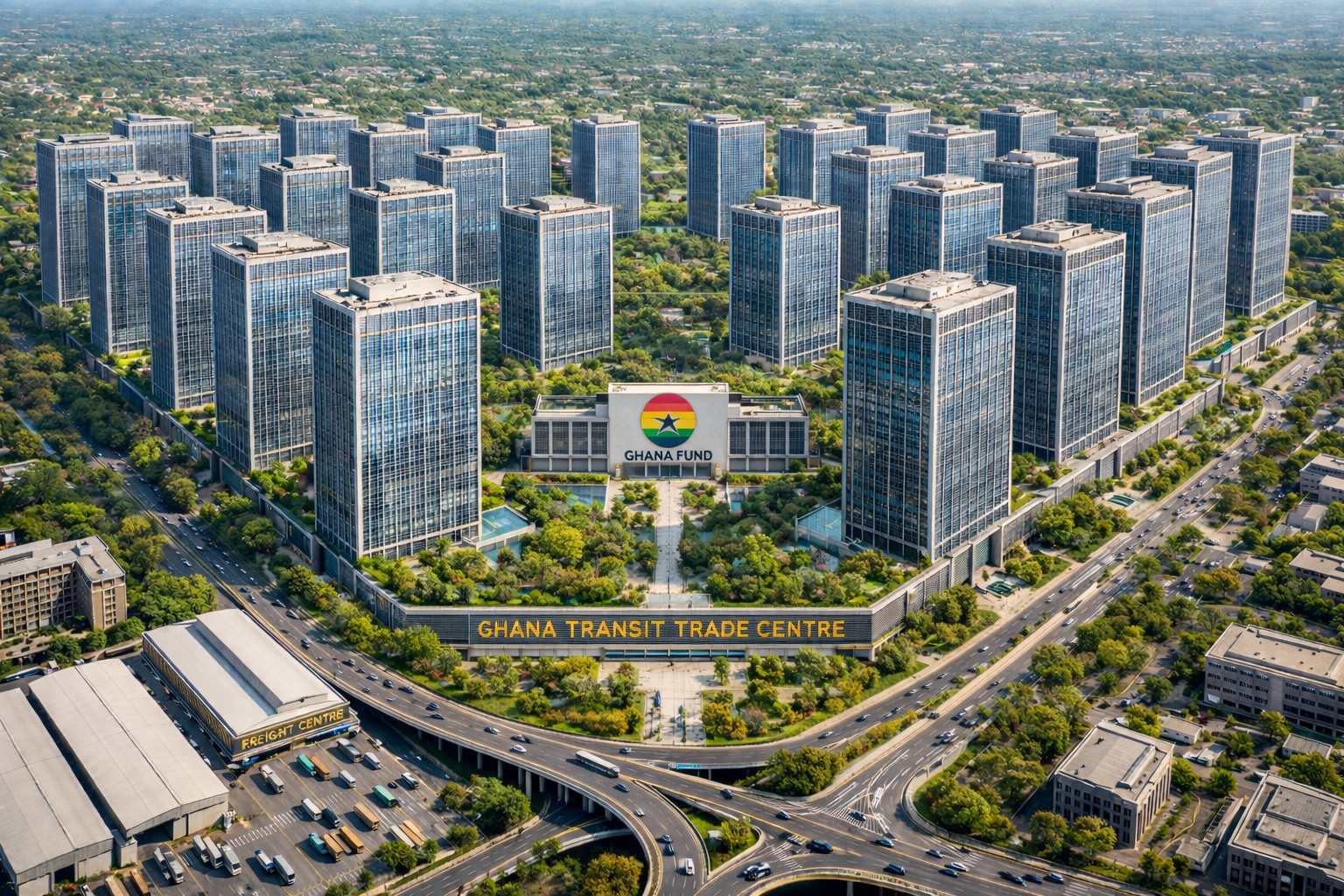
The Department of the Ghana Transit Trade Centre drives Ghana’s strategy to become West Africa’s premier logistics, warehousing, and re-export hub. It oversees modern transit corridors, bonded facilities, cross-border trade systems, and global commercial links, enabling seamless movement of goods, boosting exports, and positioning Ghana as the region’s gateway for efficient, competitive international trade.
PROCUREMENT OFFICE
Ghana Fund’s Procurement Office ensures transparent, efficient, and strategic sourcing of goods, works, and services, securing best-value contracts that uphold international standards while supporting national development goals.
ETHICS AND ANTI-CORRUPTION OFFICE
The Ghana Fund Ethics and Anti-Corruption Office safeguards integrity across all operations, enforcing strict accountability, transparency, compliance monitoring, whistle-blower protection, and zero-tolerance measures to prevent misconduct, ensure ethical conduct, and uphold public trust in the Fund’s national development mission.
GOLD DEPOSITORY
Ghana Fund Gold Depository is a national wealth engine that secures, certifies, and leverages Ghana’s gold for development finance. By converting stored gold into credit, investment capital, and sovereign assets, it fuels infrastructure, industrialisation, and long-term economic growth—anchoring Ghana’s transformation through a stable, gold-backed foundation for sustainable national prosperity.
DEPARTMENT OF INNER-CITY RE-DEVELOPMENT
The Ghana Fund Department of Inner-City Re-Development drives large-scale renewal of Ghana’s urban communities by upgrading housing, roads, markets, sanitation, and public services. It focuses on transforming high-density, underserved neighbourhoods into modern, vibrant, economically active districts. Through strategic investments, infrastructure upgrades, and social-impact programmes, the department works to improve living standards, stimulate local enterprise, and create inclusive, well-planned urban spaces nationwide.
DEPARTMENT OF AGRICULTURAL ESTATES AND CANAL DEVELOPMENT
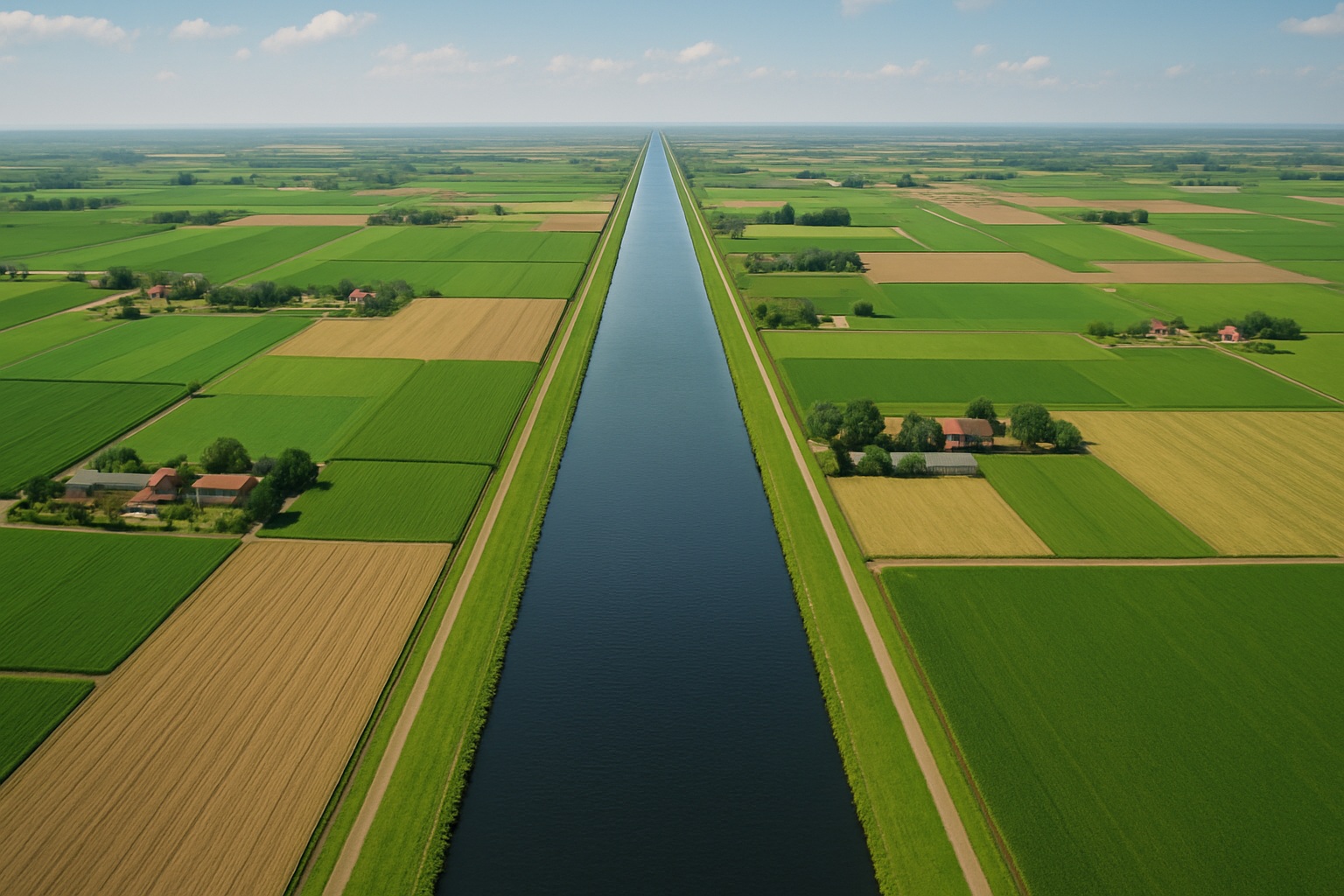
The Ghana Fund Department of Agricultural Estates and Canal Development drives large-scale agricultural transformation by developing productive farm estates and a 2,000 km canal network to ensure efficient irrigation, water management, and sustainable farming. It integrates modern agricultural technologies, climate-smart practices, and high-yield crop strategies to boost food security, create jobs, and generate economic value. By connecting farmland with reliable water infrastructure, the department enhances productivity, supports agribusiness, and strengthens Ghana’s position as a regional agricultural leader.
DEPARTMENT OF AEROSPACE
The Ghana Fund Department of Aerospace drives Ghana’s ambitions in aviation, space, and advanced aerospace technologies. It focuses on developing national aerospace infrastructure, fostering innovation in satellites, drones, and aircraft, and cultivating skilled professionals. By partnering with global leaders and investing in research, manufacturing, and training, the department positions Ghana as a hub for aerospace excellence in Africa, advancing both economic growth and technological sovereignty while supporting sustainable and secure air and space operations.
DEPARTMENT OF INDUSTRIAL CITIES AND INDUSTRIALISATION
The Department of Industrial Cities and Industrialisation at Ghana Fund drives Ghana’s transformation into a manufacturing and industrial hub. It plans, develops, and manages industrial cities, special economic zones, and industrial clusters, attracting investment, fostering local production, and creating high-value jobs. By integrating advanced technology, sustainable practices, and strategic infrastructure, the department accelerates industrialisation, strengthens supply chains, and enhances Ghana’s global competitiveness. Its mission is to turn industrial cities into engines of economic growth, innovation, and prosperity, positioning Ghana as a leading African industrial powerhouse.
AFRICA OVERSEAS COMMERCIAL EXCHANGE DEPARTMENT
The Department of Africa Overseas Commercial Exchange under Ghana Fund drives Africa’s global trade integration. It facilitates export promotion, international partnerships, and market access for African goods and services. By connecting African producers with overseas buyers, it enhances competitiveness, boosts foreign revenue, and positions Ghana as a strategic continental trade hub. The department leverages innovation, logistics, and regulatory support to streamline cross-border commerce, attract investment, and ensure fair, sustainable, and high-value trade, strengthening Africa’s presence in global markets while creating wealth and opportunities for local businesses and communities.
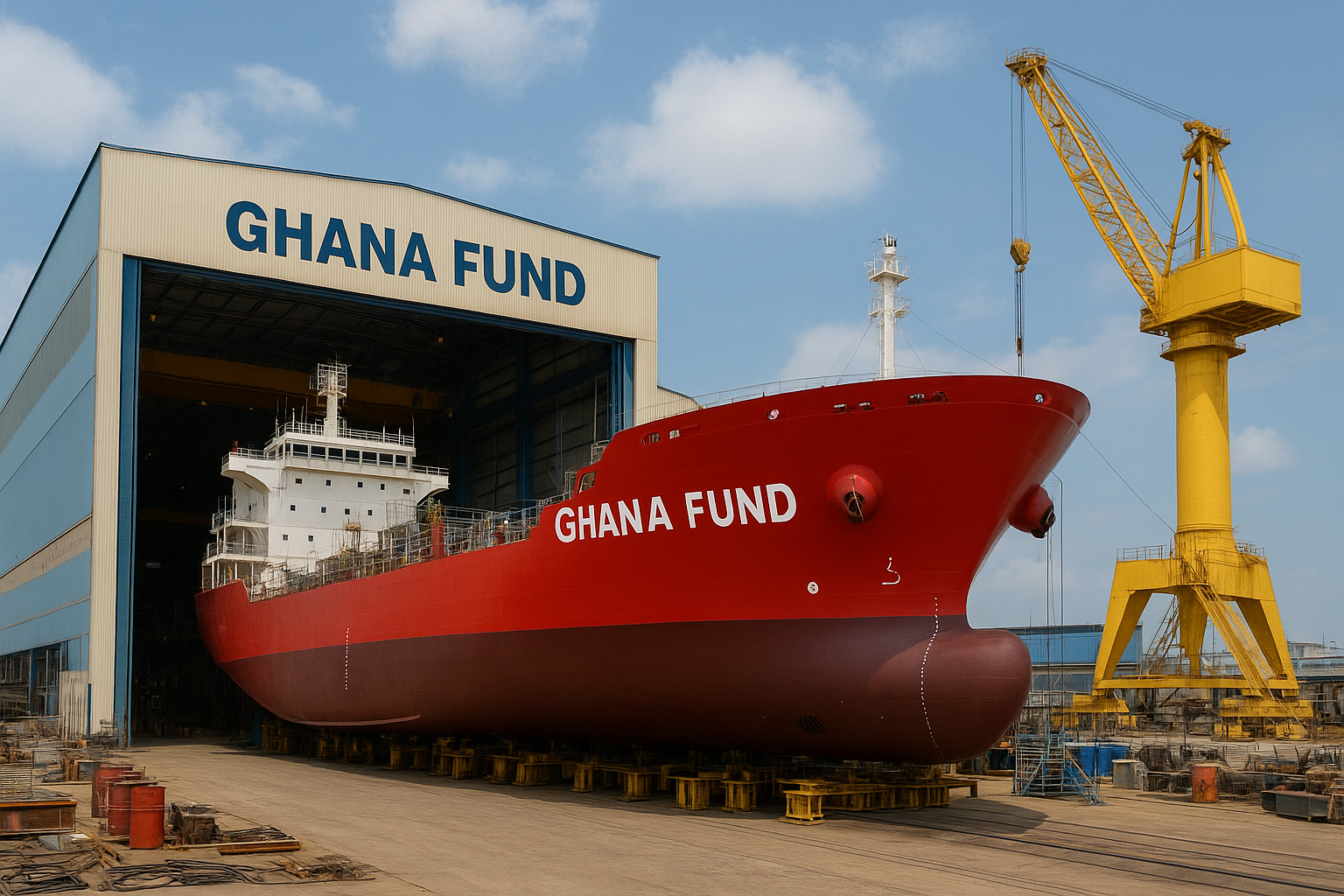
DEPARTMENT OF MARINE INDUSTRIES
The Ghana Fund Department of Marine Industries drives Ghana’s maritime growth by developing shipbuilding, port infrastructure, fisheries, and offshore energy sectors. It promotes innovation, sustainable practices, and international partnerships to enhance local capacity, create jobs, and boost economic contribution from marine resources. The department oversees regulation, research, and investment in marine technology, ensuring Ghana becomes a regional leader in maritime industries while safeguarding marine ecosystems for long-term prosperity.
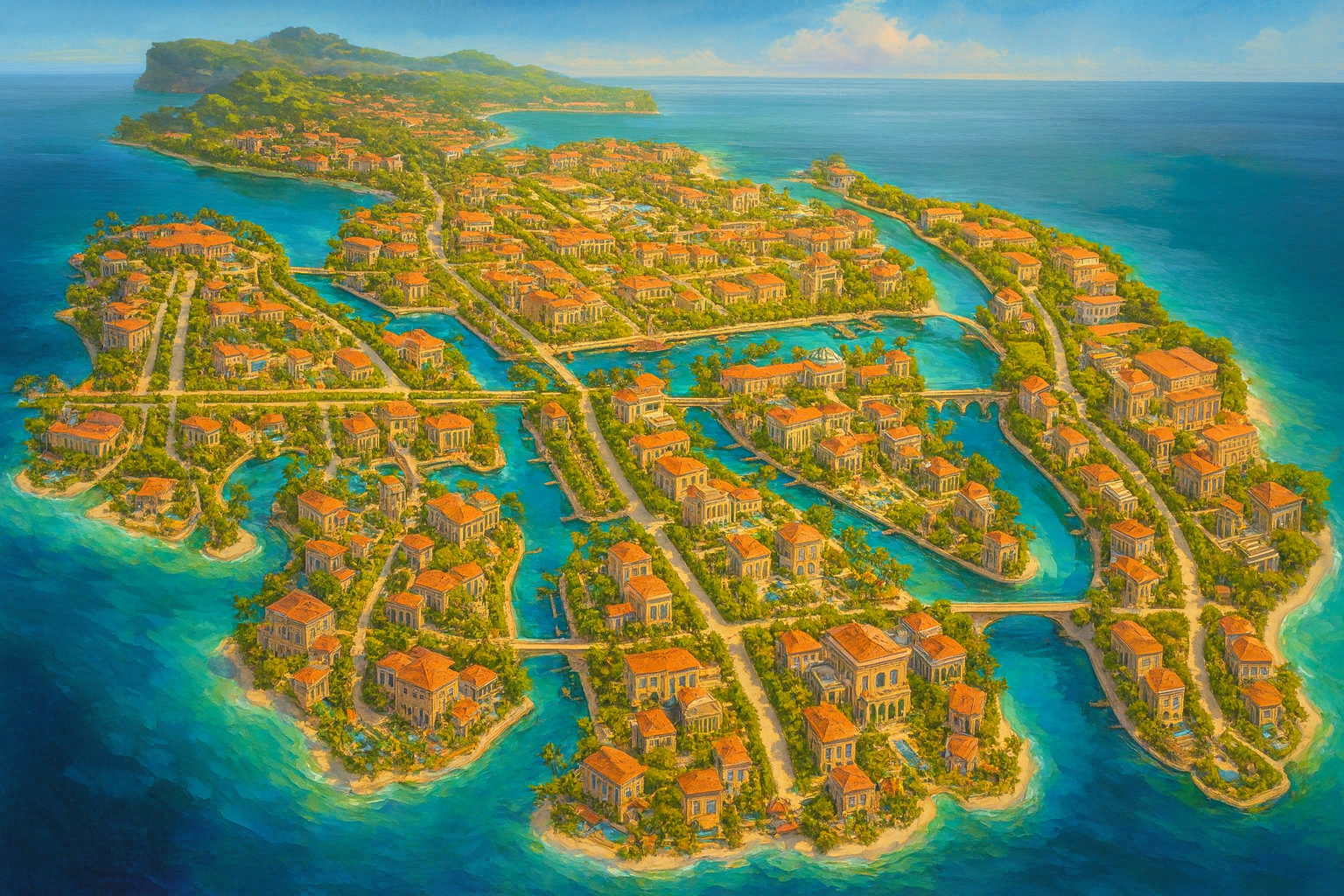
DEPARTMENT OF MARINE RESORT DEVELOPMENT
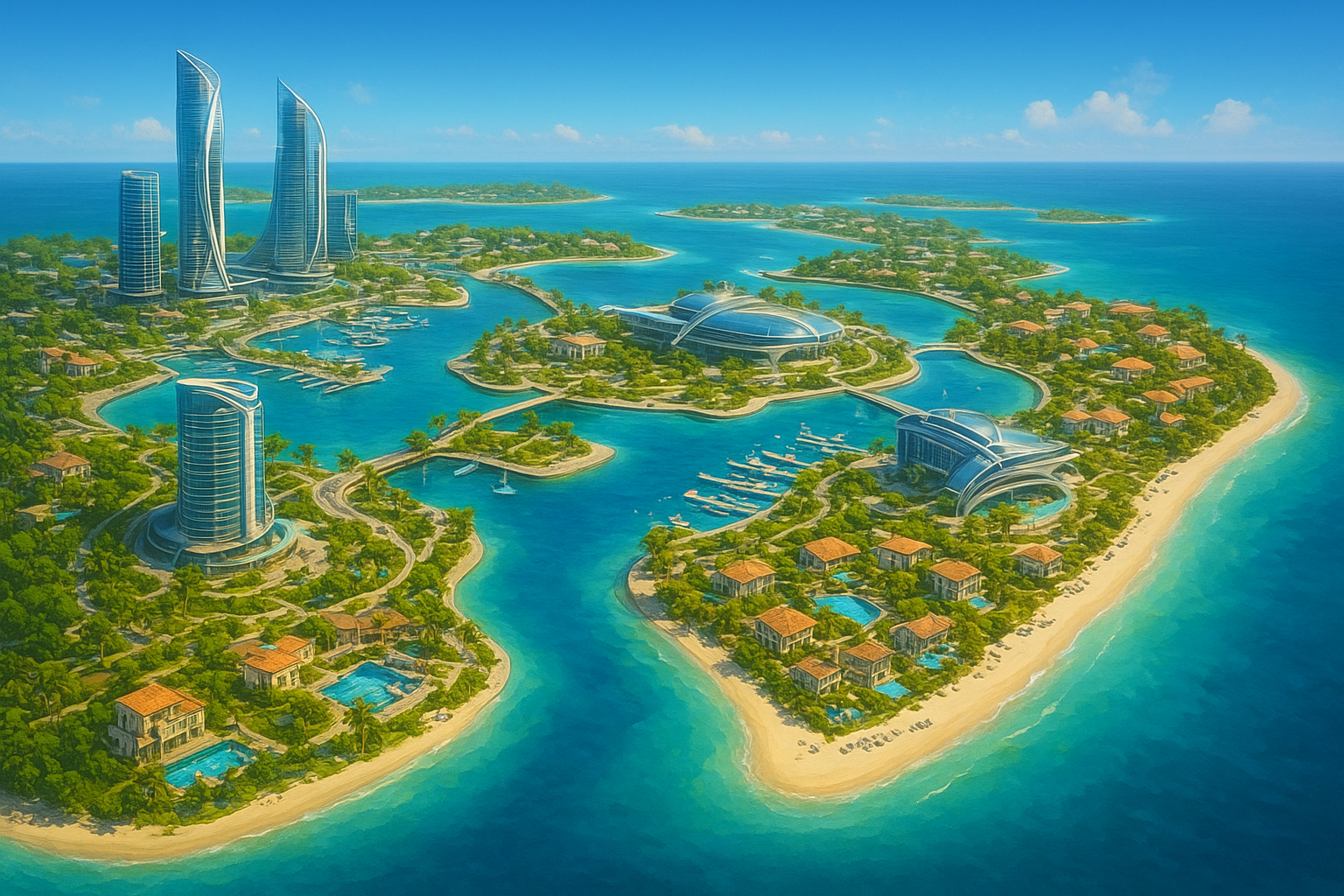
The Ghana Fund Department of Marine Resort Development spearheads the creation of world-class coastal and island resorts, integrating luxury hotels, marinas, entertainment zones, and eco-friendly tourism. Focused on boosting Ghana’s global tourism appeal, the department combines cutting-edge infrastructure with sustainable marine and cultural experiences, generating jobs, attracting international visitors, and driving economic growth. It transforms Ghana’s waterfronts into iconic destinations while preserving natural ecosystems, positioning the nation as a leader in high-end, environmentally conscious marine tourism across Africa.
DEPARTMENT OF RAILWAY INDUSTRIES
The Ghana Fund Department of Railway Industries drives the development, modernization, and expansion of Ghana’s rail infrastructure. It focuses on designing, manufacturing, and maintaining locomotives, carriages, and rail components while fostering local industry and technology transfer. By integrating advanced rail solutions, promoting public-private partnerships, and ensuring safety and efficiency, the department supports national connectivity, economic growth, and regional trade, positioning Ghana as a hub for modern, sustainable railway systems across West Africa.
DEPARTMENT OF TRANSPORT INFRASTRUCTURE AND TRANSPORTATION
The Ghana Fund Department of Transport Infrastructure and Transportation drives the development, modernization, and maintenance of Ghana’s transport networks, including roads, railways, ports, and airports. It ensures efficient, safe, and sustainable movement of people and goods nationwide, integrating innovative technologies and international best practices. By enhancing connectivity and reducing logistical bottlenecks, the department underpins economic growth, trade facilitation, and regional integration, positioning Ghana as a hub for transport excellence in Africa. Its projects aim for long-term impact, linking urban and rural areas while supporting the country’s industrial and commercial ambitions.